
The UAE property market defies global scrutiny to emerge resilient amid war
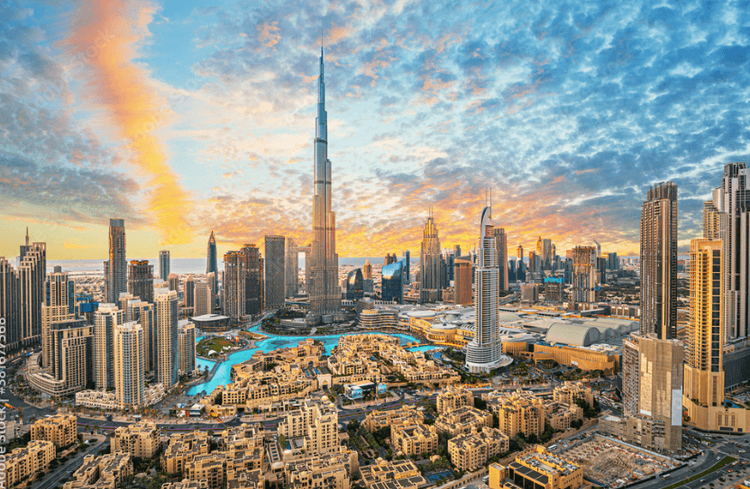
The UAE realty experienced a tumultuous first half this year, headlined by a series of skyline-defining launches followed by the geopolitical clash that quaked the region’s economy.
The UAE realty experienced a tumultuous first half this year, headlined by a series of skyline-defining launches followed by the geopolitical clash that quaked the region’s economy.
Despite the turmoil, the country’s two key real estate markets retained their appeal reflective in their performances. Dubai continued to outshine its regional peers, cementing its popularity as a global real estate hub, while Abu Dhabi maintained its fluidity.
Dubai Land Department announced that Dubai’s total transactions reached Dh252 billion in Q1 2026, marking a 31 percent year-on-year surge in value. The first half saw more than Dh286.44 billion in sales from over 86,000 transactions, making it the second-highest first-half sales performance in the emirate’s history.
Abu Dhabi’s real estate transactions reached a total value of Dh117 billion in H1 2026, demonstrating more than twice the growth from the corresponding period last year. Abu Dhabi Real Estate Centre (ADREC) revealed that sales reached 16,838 transactions worth Dh86.1 billion, exhibiting 163.7 percent growth from the same period last year.
While performances sustained their momentum, the market witnessed a shift. Launches paused, paving way for developers to secure their logistics and supply chains and focus on delivery.
As many as 104 projects completed in Dubai in H1 2026, compared to 75 from the last, marking an increase of more than 38.7 percent. The projects were worth over Dh111 billion, as opposed to Dh73 billion in H1 2025, growing by 52 percent.
According to real estate intelligence REIDIN, 141 launches comprising 50,000+ units were recorded in H1 2026. The figures dipped from the corresponding period last year, when 325 projects featuring over 87,900 homes were unveiled.
Matthew Green, Head of Research at CBRE MENA, found that the drop in launches signalled strategic recalibration among developers.
“As per REIDIN’s latest data, Dubai saw around 51,000 units brought to market in H1 2026, a significant reduction on the same period last year, with activity in Q2 alone falling to around 10,000 units across 41 projects, down from 41,000 units and 100 projects in Q1. Notably, launch positioning has shifted firmly toward the mid-market segment, as developers hold back on luxury product launches until there is greater visibility on regional conditions,” he said.
The impact has also spilled into the construction phase, effecting delivery schedules.
“We’re also seeing a continued impact on construction execution, with roughly 18,000 units completed across Dubai in H1 2026, notably lower than was expected at the start of the year. With logistical bottlenecks persisting, some planned handovers for the year have been pushed further into 2027. However, this recalibration of the delivery pipeline may ultimately work in the market's favour, tempering the scale of new supply as demand fundamentals are softening.”
This shift is viewed to be a crucial moment for developers to demonstrate their commitment to deliveries, fortify against setbacks, and strengthen investor confidence.
Farhad Azizi, Group CEO of Azizi Group, said, “A moderation in the pace of off-plan launches is not a sign of weakness; it is the sound of a market growing up. In real estate, reputation is not built in the launch gallery, it is built at the doorstep, in handed-over keys.
“Across our portfolio, with approximately 150,000 units under construction, we met global supply-chain pressures not by absorbing them but by owning our way around them. We vertically integrated procurement, design, and construction management, and we run site execution around the clock. A developer who does not control its own delivery rhythm is exposed to every shock in the chain; one who does, becomes a shock absorber for its buyers. That is the difference between promising a home and guaranteeing one, and it reinforces confidence across the entire ecosystem.”
Retaining positive sentiments among global investors posed to be a challenge when the crisis peaked.
“Confidence from non-resident investors was hit when the tensions peaked. It is a high bar to invest outside the country of your domicile, and perceived risk was elevated. Conversely, resident investors stayed positive, and they could see firsthand how safe they and the country were,” Ben Crompton, Managing Partner at Crompton Partners, said.
Dubai’s long-term appeal as an investment hub has buffered much of the negative sentiments. “International investors do not judge this city by the lens of short-term regional noise; they weigh it on institutional certainty, the rule of law, personal safety, and something the commentary consistently misses: opportunity. Dubai is not merely a safe place to preserve wealth, it is a fertile place to grow it, with a business-conducive environment, a lifestyle few global cities can rival, and a government that treats ease of doing business as a national mandate,” Azizi added.
Foreign investment in Dubai real estate reached Dh148.35bn in Q1 2026, jumping 26 per cent year on year. As many as 48,448 property investors were recorded during Q1, out of which 29,312 were new investors. In Abu Dhabi, Dh13.8 billion in foreign direct investment (FDI) was recorded during the first half of 2026, surging 309 percent year-on-year. The value recorded during the first six months of the year surpassed the total achieved throughout 2025, marking the highest level of FDI ever recorded during the first half of a year. Serious buyers look at facts and figures rather than global scrutiny.
“In Dubai, daily life carried on entirely as normal - businesses open, families out, not a beat missed. Sophisticated capital understands this instinctively. Family offices and institutional funds do not trade on the drama of a news cycle; they trade on evidence. They look past the noise to the fundamentals: a market anchored by real equity, healthy cash-to-mortgage ratios, ironclad escrow protections under RERA, and rental yields that consistently outperform cities like London or New York. If anything, these moments clarify the picture, separating conviction-driven investors from momentum chasers. The smart money reads the data, not the drama, which is why capital inflows have stayed remarkably resilient through every burst of external noise,” Azizi said.
Market stability is not far, analysts said, citing that predicted upward economic trajectory will boost performance once the crisis ceases.
“According to Oxford Economics, the UAE’s non-oil sectors are poised for growth by 2027, with national GDP expected to reach 6.4% as regional trade and business activity normalize. We view this environment as a natural cyclical adjustment, with the market well-prepared to regain stability once external pressures subside,” Green said.
“Both the IMF (5.3%) and the Central Bank (9.8%) have predicted significant economic growth for the UAE in 2027. A better economy means jobs, and jobs require people to come in to fill them and take up real estate. The future looks bright for UAE property sales,” Crompton concluded.
Ends