
Dubai ranks 4th tallest city in the world in 2026
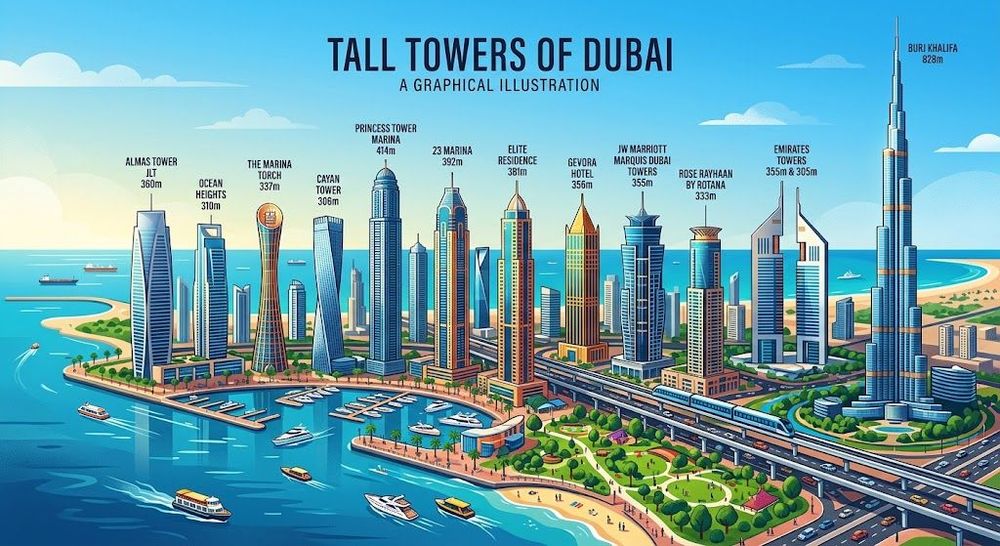
The city of Dubai is solidifying its position as one of the tallest cities in the world and the first in the Middle East region, according to Council on Vertical Urbanism, the global market intelligence provider on tall towers.
The global race for taller skylines is heating up. A major shift has happened—the UAE SuperTall skyscrapers have officially passed the United States in 2025. This marks a big change in the high-rise world.
With 37 buildings over 300 metres, the UAE has taken the second spot globally, while the US trails behind with 31. China, however, still leads by a large margin, according to the Council on Vertical Urbanism (CVU), the global authority on tall towers.
SuperTall skyscrapers are buildings that stand over 300 metres tall. These towers have become a symbol of modern urban development and city identity.
In previous years, the US led the global high-rise movement. But in 2025, the UAE superseded the US.
“While the US continues to build, its pace is slower. Developers often face delays due to local regulations and limited urban land,” said a report by Primo Capital.
“In contrast, the UAE keeps pushing vertical limits. Dubai alone has dozens of high-rise projects. This growth is not just about numbers—it’s about vision. That’s why UAE Supertall Skyscrapers are outpacing others, especially the US, in both scale and speed.”
A project in Dubai moves quickly — from design to handover. Some towers are completed in four to five years. In the US, similar buildings may take up to a decade due to longer approval times and stricter regulations.
“Dubai also benefits from a more flexible urban planning process. Developers have more control over land, timelines, and building specs. This leads to faster delivery and quicker returns. That’s why UAE SuperTall Skyscrapers rise faster—and in greater numbers—than their US counterparts,” the report emphasised.
Dubai currently holds the record of hosting the world tallest tower – Burj Khalifa – for more than 16 years. The city is also home to around 15 of the world’s tallest 100 towers in the world. Dubai also hosts 15 of the world’s tallest 100 towers, CVU data shows.
As of July 2026, twelve of the world's 20 tallest buildings under construction are in Dubai, reinforcing the emirate's position as the Middle East's skyscraper capital, according to Gulf Property research on tall buildings.
By the end of the decade, Dubai is expected to add several new SuperTall skyscrapers exceeding 500 metres, further widening its lead as the city with the world's largest concentration of ultra-tall buildings outside China. All of the 12 tallest skyscrapers currently under construction in the UAE are in Dubai, highlighting continued investment in luxury real estate and tourism.
Dubai has more than 134,081 registered building units, according to old municipal census records from CEIC Data, though modern urban growth has expanded significantly beyond these figures.
Dubai Municipality licensed 4,305 buildings in the first half of 2026, marking a 37.4 percent increase compared to the same period in 2025. There are 24,000 new buildings under construction and development.
In addition to hosting the world’s tallest tower, Dubai until recently hosted the world’s all-hotel tower - JW Marriott Marquis hotel on Sheikh Zayed Road that stands tall at 355 metres high above the ground.
Property developers in Dubai and the UAE are racing against time to deliver more skyscrapers that will reinforce the emirate’s position as the global hub of tall towers.
Dubai has 564,072 residential properties currently under construction, according to a report. Of these, 75 percent or 425,863 units have already been sold out to buyers and investors.
As many as 96,585 homes are scheduled to enter the market during 2026, of which roughly 83 percent or 80,127 units are already sold out.
In 2025, a total of 114,004 properties were launched in Dubai. The number has reached 67,305 in the first eight months already, despite the regional uncertainty that has discouraged many foreign buyers.
The number of homes expected to be delivered this year is estimated to be around 72,000, while it is expected to jump to 12,000 units, according to Dubai Land Department data.
The total value of 4,729 real estate, infrastructure and construction projects in Dubai currently exceeds US$621.16 billion (Dh2.28 trillion), according to BNC Networks, which tracks construction projects in the Middle East.
Dubai's active projects encompass a total value of US$174.1 billion, with urban construction accounting for around 74 percent, approximately US$128 billion. Anchored by the Dubai 2040 Urban Masterplan, the city seeks to revolutionise urban living and working. Key components of this plan include Palm Jebel Ali, Dubai Islands, five Urban Centres, and other developments.
Upcoming landmarks encompass the Bugatti Residences, Al Habtoor Tower - aiming to be the tallest residential building - , and Burj Binghatti. The city's focus spans hospitality projects to boost tourism GDP contributions and high-end luxury residences to attract affluent residents and real estate investments. Community development initiatives include Oasis by Emaar, Valley by Emaar, Port De La Mer De La Sirene, Damac Lagoons, South Bay residential district and more.
“Dubai takes strides towards renewable energy, with over 25 percent of active utility projects dedicated to renewables, including the Mohammed Bin Rashid al Maktoum Solar Power Park, the world's largest single-site solar facility,” BNC Networks said in a recent report.
“Dubai's commitment to sustainability extends to a centennial sewerage system, part of the Dubai Urban Master Plan 2040, intended to serve the population for a century. Noteworthy utility projects encompass the Hassyan coal-fired power plant, Waste-to-Energy plant in Warsan, Hassyan Seawater Reverse Osmosis Desalination Plant and Dubai/EDF Thermal Power Plant.”
While emphasising luxury, Dubai allocates US$5.2 billion to industrial projects in zones like Jebel Ali Industrial Zone, Jebel Ali Free Zone and Dubai Industrial City. Transport initiatives comprise almost 42 percent of UAE's active transport projects. The Al Maktoum International Airport, valued at US$36.44 billion, aspires to be the world’s largest by 2050.
Ongoing research delves into the viability of the Hyperloop project, alongside expansion efforts for the Dubai metro, valued over US$4 billion. Foster & Partners' conceptual vertiport design underscores Dubai's innovation-driven transformation into a futuristic metropolis.
Dubai's urban landscape is undergoing a massive transformation guided by the Dubai 2040 Urban Master Plan. This strategic blueprint aims to make Dubai the "best city for living in the world" by focusing on sustainability, connectivity and a people-centric approach to counter its historically car-dependent, sprawling layout.
By 2040, the city's population is projected to reach 7.8 million (up from approximately 3.3 million when the plan launched), prompting a massive shift toward high-density, multi-centric development.
In terms of single-tower height, the UAE leads with the Burj Khalifa over all other countries. But China has more skyscrapers overall.
“While China’s numbers are higher, the UAE focuses on standout buildings. It’s not just about quantity — it’s about bold vertical designs. This strategy has helped Skyscrapers in UAE 2025 gain global attention and influence,” Primo Capital said in its report.
“Expect more high-rise projects in both countries, but the UAE is closing the gap in quality and design. The UAE Supertall Skyscrapers story is more than a number game. It’s about a shift in ambition, speed, and scale.
“With 37 buildings over 300 metres, the UAE now ranks second in the world. Its lead over the US shows how planning and execution drive results. The skyline is changing—and the UAE is at the centre of it. As China holds the top spot for now, the real question is: will the UAE be the next to lead? The race is on.”
Luxury Properties
Investment in luxury properties in Dubai has accelerated over the last few years with the city recording deals worth Dh200-500 million per villa or mansion.
Developers recorded 244 off-plan residential sales above Dh5 million last month, with a combined value of Dh3.42 billion. The transactions ranged from the Dh5-10 million bracket through to the Dh50-100 million range, showing that demand extends across a broad spectrum of the luxury market. An analysis by Dubai luxury developer Keturah reveals there were 151 off-plan apartment sales amounting Dh2.3 billion in July, while 93 villa transactions generated Dh1.1 billion. The average value across last month’s residential off-plan deals was Dh14 million. While the Dh5-10 million bracket accounted for the largest number of apartment transactions, with 81 sales worth Dh552.6 million, a significant proportion of the total value came in the higher price brackets.
Data from DXBinteract shows there were 41 sales between Dh10 million and Dh20 million worth Dh593.6 million, while a further 24 transactions between Dh20 million and Dh50 million generated Dh708.5 million.
“Dubai’s luxury market is demonstrating a depth of demand that goes beyond individual high-value transactions,” said Talal M. Al Gaddah, CEO and Founder of the Keturah luxury brand.
“Investors are continuing to commit substantial capital to Dubai residential property because they see that the city’s long-term fundamentals, international appeal and investment proposition remains strong.”
Influx of foreign capital rose 26 percent in Q1 2026 as Dubai attracted 29,312 new property investors, reinforcing signs that the market is shifting from cyclical recovery to structural growth.
Foreign capital is becoming an increasingly important driver of Dubai's property market, with international real estate investment reaching Dh148.35 billion in Q1 2026, up 26 percent year on year, according to Dubai Land Department.
Total real estate transactions reached Dh252 billion during the quarter, rising 31 percent in value and extending a growth cycle that has pushed the market beyond its previous records.
Top 10 under-construction skyscrapers in the UAE
Dubai is expected to add several new SuperTall skyscrapers exceeding 500 metres by 2030, further widening its lead as the city with the world's largest concentration of ultra-tall buildings outside China. All of the 10 tallest skyscrapers currently under construction in the UAE are in Dubai, highlighting continued investment in luxury real estate and tourism, as per the Skyscraper Centre.
No. Building Height(metres) Location Completion Developer
1. Burj Azizi 725 Sk Zayed Road, Dubai 2028 Azizi Developments
2. Burj Binghatti Jacob&Co Res. 595 Business Bay, Dubai 2027 Binghatti Developers
3. Tiger Sky Tower 532 Business Bay, Dubai 2029 Tiger Properties
4. Six Senses Residences 517 Business Bay, Dubai 2028 Select Group & Six Senses
5. Franck Muller Aeternitas Tower 450 Dubai Marina 2027 London Gate
6. Bayz 101 by Danube 363 Business Bay, Dubai 2028 Danube Properties
7. Bayz 102 by Danube 362 Business Bay, Dubai 2028 Danube Properties
8. Binghatti Skyblade 357 Downtown Dubai 2029 Binghatti Developers
9. Trump Int’l Hotel & Tower Dubai 350 Downtown Dubai 2031 Dar Global
10. Rixos Dubai Residences 348 Downtown Dubai 2028 East & West Properties
11. Al Habtoor Tower 345 Al Habtoor City, Dubai 2027 Al Habtoor Group
12. Mercedes-Benz Places 341 Maydan, Dubai 2028 Binghatti Developers
Ends